Backend Infrastructure That Lets Products Ship
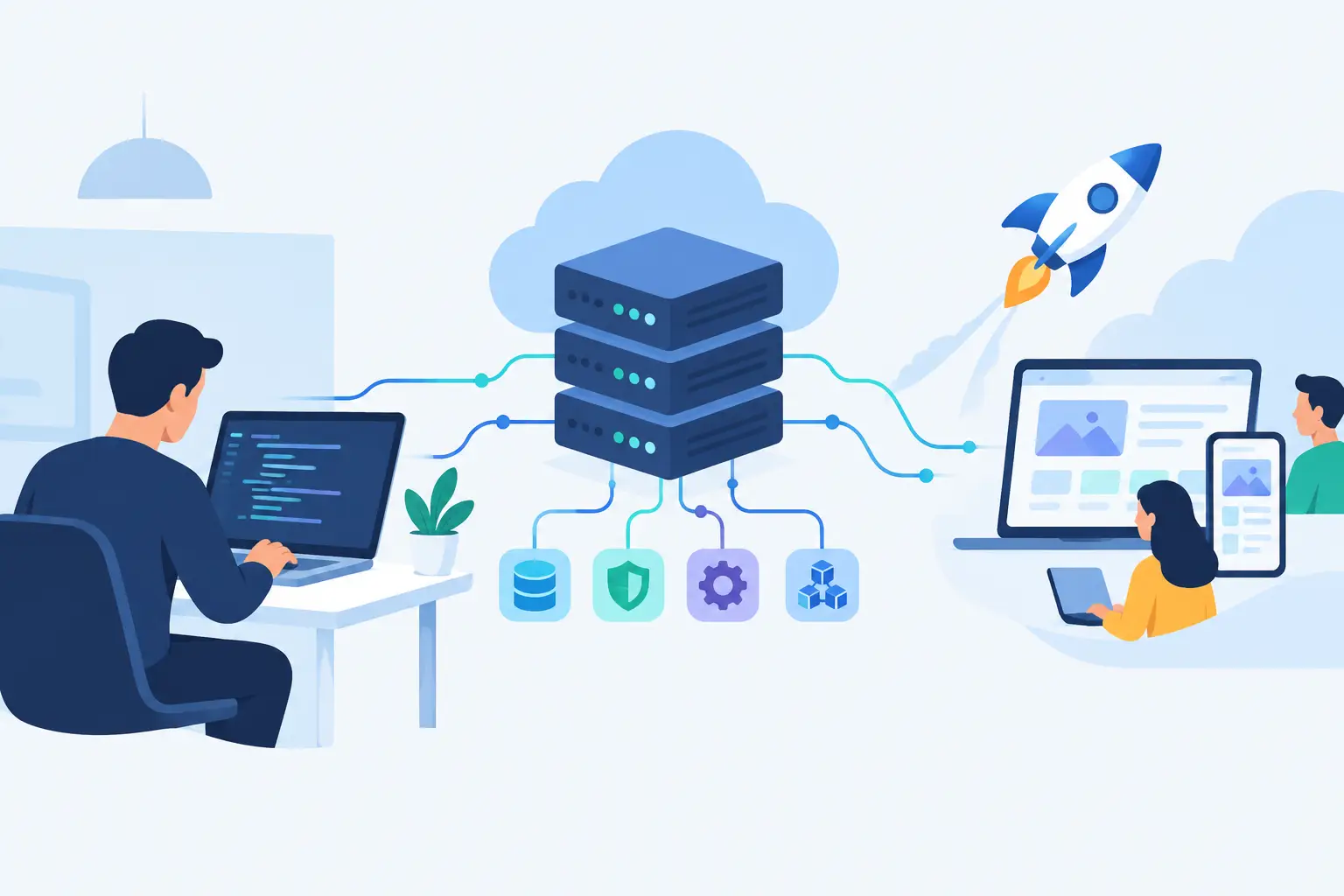
A product can look finished and still fail the first time real people rely on it. A signup works, then an email arrives twice. A dashboard feels fast until one customer imports a larger file. A small configuration change takes down a workflow because nobody can tell which service owns it. Backend infrastructure is where those avoidable problems are decided, usually long before users see them.
For a small product team, the goal is not to build an elaborate platform. It is to make the product dependable enough to change. That means clear boundaries, boring deployment paths, useful data models, and enough visibility to answer a simple question quickly: what happened?
Backend infrastructure is product infrastructure
It is tempting to treat the backend as support work that begins after the interface is designed. That creates expensive surprises. Product decisions often carry backend consequences: whether users can collaborate, whether actions need an audit trail, how long data is retained, whether a feature works offline, and which systems receive customer data.
A good backend makes those consequences explicit. It gives the product a stable way to store information, apply rules, expose APIs, run background work, and recover when something goes wrong. It also prevents every new feature from becoming a special case stitched into the last one.
The right amount of infrastructure depends on the product. A focused internal tool does not need the same architecture as a multi-tenant application with integrations, scheduled jobs, and compliance requirements. Starting small is sensible. Starting vague is not.
The API should reflect real product rules
An API is not just a route that moves JSON from one place to another. It is a contract for what the system allows. If a user can cancel a scheduled action, the backend must define when cancellation is possible, what happens to work already in progress, and what the interface should show afterward.
Those rules belong in a deliberate service layer rather than being scattered across browser code, database triggers, and one-off scripts. Centralizing them makes behavior easier to test and makes native apps, web clients, and future integrations less likely to disagree.
Good API design also means being specific about failure. A useful response tells the client whether to retry, ask the user to fix something, or stop. Generic errors may be quick to return, but they turn debugging into guesswork and make polished UX harder to deliver.
Data models need room for reality
Early schemas often describe the happy path: a user has a record, a record has a status, and the status changes. Real products soon introduce drafts, deleted items, permissions, retries, imports, edits, and support requests asking why something changed.
That does not mean every table needs a dozen speculative columns. It means choosing names and relationships that match the domain, keeping migrations reviewable, and preserving history where the product needs accountability. A billing event, permission change, or automated action may need an immutable record. A temporary UI preference probably does not.
Privacy belongs in this conversation from the first schema. Collect only what the feature requires. Separate operational logs from product data. Decide who can inspect sensitive values, how long they remain available, and how deletion works across backups and downstream services. A privacy policy cannot repair an architecture that casually distributes customer data to unnecessary systems.
Build the smallest deployable system
Teams often inherit a false choice: either ship a single application forever or split everything into microservices. For many early products, one well-organized application, a primary database, and a background-job mechanism are enough. Add managed services where they remove real operational work.
A modular monolith is not a compromise. It is frequently the fastest way to keep business logic close together while preserving boundaries inside the codebase. Modules can own their data access, rules, and interfaces without requiring network calls for every internal operation.
Services become worthwhile when a boundary is proven, not imagined. Independent scaling, distinct security requirements, different release schedules, or a genuinely separate domain can justify a split. “We might need it later” usually cannot. Distributed systems add latency, deployment coordination, failure modes, and more places for ownership to become unclear.
The deployment path deserves the same discipline. A change should move from review to a predictable environment, run automated checks, and produce an identifiable release. Rollback should be understood before the emergency, not invented during it. Database changes need particular care because application code can often roll back faster than data can.
For client work, uAgency treats this as part of delivery rather than a handoff document: the people making product decisions also account for how the feature will be operated after release. No process theater, and no architecture diagram that cannot survive a normal week of changes.
Make failures visible and recovery practical
Many teams add monitoring after the first incident. By then, the most valuable clues may already be gone. Observability does not require an enormous operations stack. It requires enough signal to follow a customer action through the system and identify where it slowed, failed, or produced an unexpected result.
Start with structured logs that include a request or job identifier, meaningful error reporting, and a small set of service metrics. Watch the things customers feel: request latency, error rate, queue delay, failed background jobs, database pressure, and third-party dependency failures. A graph with no action attached is decoration.
Alerts should be rare and actionable. Paging a person for every noisy exception trains people to ignore the channel. Alert when the product is materially degraded, a critical workflow is failing, or intervention is needed. Everything else can be reviewed through dashboards and regular maintenance.
Monitoring alone does not make a system reliable. Define how much downtime and data loss the product can tolerate, automate backups, and periodically restore them in an isolated environment. Verify that the restored data is usable and measure how long recovery takes. A successful backup job is not proof that the product can recover.
Background work needs first-class rules
Emails, imports, media processing, report generation, and synchronization should rarely happen inside a request that a user is waiting on. Queues and workers make the interface responsive, but they introduce their own product rules.
Jobs should be safe to retry. They should have timeouts, visible states, and a plan for failures that will not resolve on their own. If a worker processes the same task twice, the result should not duplicate an invoice, send duplicate notifications, or corrupt a record. This is where idempotency stops being an engineering term and becomes customer trust.
Third-party APIs need similar caution. They can rate-limit, return partial results, change behavior, or go down. Store only what you need, set clear retry policies, and avoid making the entire product unavailable because one optional integration is having a bad day.
Security is a set of operating decisions
Security is not one authentication library or a checklist completed before launch. It is a series of choices about access, secrets, updates, and recovery. Who can perform an administrative action? How are credentials stored and rotated? Can a developer access production data casually? What happens when a dependency reports a serious vulnerability?
The practical baseline is straightforward: enforce authorization on the server, validate inputs at boundaries, keep secrets out of source control, encrypt data in transit, restrict production access, and keep dependencies current. Then test the paths that matter most, especially account recovery, permission changes, file access, and administrative tools.
There are trade-offs. Stronger controls can add friction for internal teams. More detailed audit logs can increase data retention responsibilities. Managed infrastructure can reduce operational burden while limiting some low-level control. Good decisions state those trade-offs plainly instead of pretending every choice is free.
Design for change, not a fantasy finish line
Backend infrastructure earns its value when the product changes without breaking its own foundation. The best test is not whether the system looks sophisticated. It is whether a team can add a feature, investigate a customer report, deploy a fix, and understand the data path without needing a heroic effort.
That takes ownership more than scale. Keep the architecture readable. Document the decisions that are hard to infer from code. Remove abandoned paths before they become permanent liabilities. Build the next reliable step, then let real product pressure show where more complexity is justified.
Customers never applaud a clean migration or a well-behaved queue. They notice when their work is there, their data is handled with care, and the product does what it said it would do. That is the standard worth building toward.