API Backend Development Services for Reliable Products
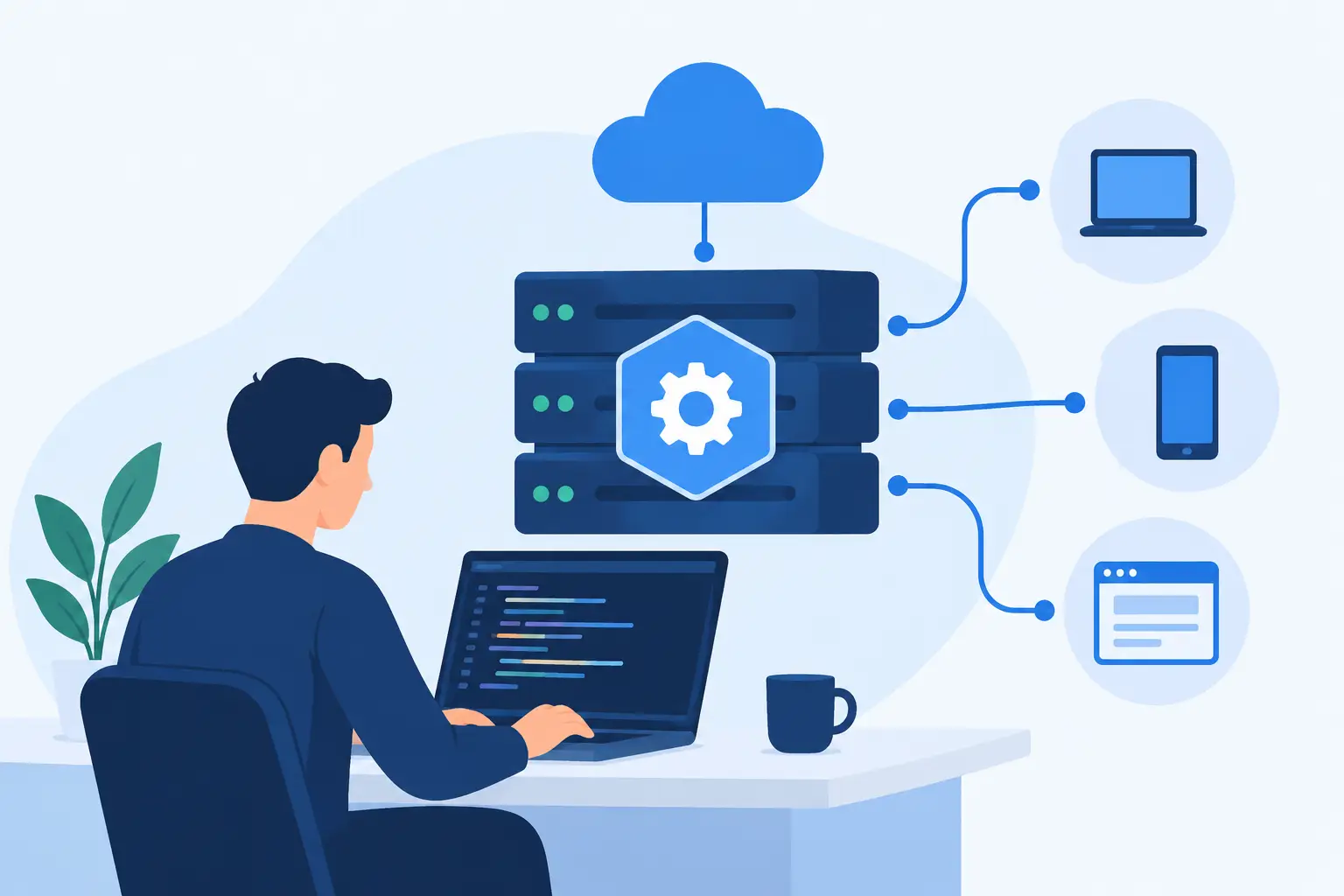
A product can look finished while its backend is still making promises it cannot keep. A traffic spike, a delayed webhook, an expired token, or a duplicate payment event exposes the gap. API backend development services are meant to close it: turning product behavior into dependable systems that handle data, permissions, failures, and change without creating a maintenance problem for the next team.
For founders and product teams, the goal is not a large architecture diagram. It is a backend that fits the product you are actually shipping, gives the team clear operating rules, and leaves room to grow without rebuilding everything six months later.
What API backend development services should deliver
A backend is more than a collection of endpoints. It defines who can access data, where business rules live, how systems communicate, what happens when a request fails, and how engineers find the cause when something goes wrong.
Good API backend development services start with those product questions before selecting a framework or managed service. A marketplace, for example, needs careful authorization, payment-state handling, and auditability. A collaborative tool may need real-time updates and conflict rules. An internal operations app may benefit more from clear role controls, reliable imports, and a simple administrative workflow than from elaborate distributed systems.
The right output is usually concrete: an API contract, a data model, an authentication model, deployment setup, monitoring, and documentation that explains how the system behaves. The details matter because they become the agreement between the web app, mobile clients, integrations, and the people maintaining the product.
An API contract people can work with
An API should be predictable before it is clever. Consistent resource names, clear request and response shapes, useful errors, and documented pagination save time across every client application. Versioning decisions should be explicit too. Some products can evolve endpoints in place for a long time; others need versioned contracts because outside customers or partner systems depend on them.
The trade-off is real. Designing every possible future capability early slows delivery. Designing nothing beyond the immediate screen creates breaking changes later. A practical approach designs for the next known stage of the product, while keeping boundaries clear enough to extend.
Data modeling that reflects the business
Databases do not fix vague product rules. If an order can be canceled, partially refunded, retried, or disputed, those states need definitions before tables and API routes are written. If users belong to organizations, the system needs a clear answer to who owns records, who can invite others, and what happens when membership changes.
This is where senior backend work earns its keep. It turns ambiguous language such as “admins can manage projects” into specific authorization rules that can be tested. It decides which data needs a history, which data can be updated in place, and which operations must be safe to retry.
API security is part of the contract
Authentication identifies the caller; authorization determines whether that caller can access a specific record or function. Every endpoint that accepts an object ID needs a server-side object-level authorization check. Request bodies and query parameters should be validated, payload and page sizes should be capped, and rate limits should protect sensitive or expensive operations. Webhook endpoints should verify provider signatures before processing events.
These controls reduce the chance that a predictable API becomes a source of data exposure, privilege escalation, denial of service, or unexpected third-party costs. They belong in the design and tests from the beginning, alongside the happy-path behavior.
Build for failure, not just the happy path
Many production backend bugs are not caused by a failed database connection in isolation. They appear at boundaries: a third-party provider times out after processing a request, a client retries after losing its connection, or two events arrive in an unexpected order.
A useful backend handles these conditions deliberately. Payment and webhook handlers should be idempotent, meaning the same event can be received more than once without producing duplicate work. Long-running tasks should move out of a request cycle when appropriate. External integrations need timeouts, bounded retries with exponential backoff and jitter, and records that make failures visible rather than silently discarded. Retries should be limited to operations that are safe to repeat, or protected by an idempotency key.
Observability is part of the build, not a cleanup task after launch. Structured logs, error tracking, health checks, and meaningful alerts make it possible to diagnose a production issue without guessing. The goal is not to collect every event forever. It is to retain the signals needed to answer basic questions quickly: what failed, for whom, after which deployment or configuration change, and what the system did next.
Privacy has to reach the backend
Privacy-first product work is often discussed as a user interface decision: ask for less, explain permissions clearly, avoid unnecessary tracking. Those are good defaults. The backend determines whether the promise holds when data moves between services.
Start with data minimization. Store only what the product needs to function, and set retention rules for everything else. Separate account identity from sensitive product data where that reduces exposure. Keep secrets out of source control and logs. Make administrative access intentional, limited, and reviewable.
There is no universal answer to whether data should be processed locally, in a private backend, or through a third-party service. It depends on the feature, device capabilities, legal requirements, cost, and user expectation. The important part is being specific. If a feature sends content to an external model provider, say so. If data is retained for support or analytics, define why and for how long. Vague privacy language creates risk for users and teams alike.
Avoid architecture theater
A small product does not automatically need microservices, a message broker, multiple databases, and a complex Kubernetes setup. Those tools can be justified at scale or when a system has distinct workload and ownership boundaries. They can also bury a small team under deployment and debugging work.
For many early products, a well-structured application, a relational database, background jobs, object storage, and managed deployment are enough. The architecture should make common changes safe and understandable. Splitting a system apart is easier when responsibilities are already clear; combining prematurely fragmented services is rarely pleasant.
The opposite mistake is treating a prototype as permanent. If the product has proven demand, it may be time to replace scattered business logic, ad hoc permissions, and manual production fixes with defined services and tested workflows. The question is not “Is this enterprise-grade?” It is “What will fail next if usage doubles, the team grows, or an integration becomes unavailable?”
A better way to run backend work
The most efficient engagements keep product judgment close to implementation. That means the people discussing edge cases with a client can make the engineering decisions, rather than passing requirements through account management layers and hoping context survives.
At uAgency, backend work is approached as part of the product, not an isolated technical deliverable. That can include API design, data systems, deployment infrastructure, AI-enabled features, and audits of an existing codebase where the fastest path is to fix what is already there rather than replace it.
A useful working sequence is straightforward. First, identify the core user actions and the data each one requires. Next, define permissions, state changes, and integrations. Then build the smallest dependable path through those actions, including tests for the failure cases that matter. Finally, deploy with visibility from day one and document the decisions that another engineer will need to understand.
That sequence reduces expensive surprises. It also gives product teams better decisions earlier, when changing a data model or access rule is still cheap.
Questions worth asking before you hire
Before choosing a team for API backend development services, ask how they handle authentication and authorization, how they test retries and duplicate events, and what their deployment and rollback process looks like. Ask who will actually make technical decisions and whether the system will be documented well enough for an internal engineer to take over.
Also ask what they would not build yet. A capable partner should be able to explain where complexity is unnecessary, not just offer a longer implementation plan. Speed comes from reducing the right work, not skipping the difficult parts.
The backend should make the product easier to trust: for users, because their data and actions are handled with care; and for the team, because the system has understandable rules when real-world conditions stop behaving like a demo.
If your product needs a backend that can survive its first real traffic spike, talk to uAgency about your backend. We can help with API design, data modeling, integrations, deployment, and an audit of an existing system.